Blog

Progress report

How much? We processed 61 large bags of sediment for dermal denticles, totaling 534kg (1177lbs). This is equal to 6 baby elephants at birth or a small mature great white shark.

How long? Processing this massive amount of sediment took about three months total, although we’re still picking out some of the denticles. Fortunately, many of the processing steps could be done simultaneously:

~2 months washing and sieving the samples

~3 months digesting the carbonate with acid, split into six rounds of digestions. This ate up nearly 265L (70 gallons) of acetic acid.

~1.5-2 months picking for denticles

Now how much does it weigh? The acid digestions reduced our load of sediment to around 6kg total. That’s about a 99% reduction in weight. Now that’s much easier to sort through!

How many denticles have we found so far? We’ve currently found about 150 denticles of various forms, but we still have more to pick!


Yamilla Samara reflects

The first big experience I had as a marine biology student was being an intern as part of a scientific investigation at the Smithsonian Tropical Research Institute in Panama. I had the opportunity to help Erin Dillon with her project by processing sediment samples for dermal denticles. During the past three months, I learned a lot about shark dermal denticles’ morphology and physiology. I also practiced the methods to process marine sediment (washing, drying, digestion, peroxide, and picking) in order to collect the denticles from each sample. The skills I developed through this internship helped me comprehend what lab work is like, how long the procedure can be, and how patient a scientist has to be in order to collect data and get results. In the end, I gained priceless knowledge, and helping Erin was another experience that confirmed my passion for marine life.

-Yamilla Samara

What’s next for Yamilla?: Yamilla is now headed to Florida International University as a transfer student to continue pursuing her studies in marine biology. She’s very excited to take upper division classes, explore the multitude of topics within the field of marine science, and further refine her interests.

How to find a denticle

How do we move from the residue remaining after a round of acid digestions to an isolated denticle ready for measurement and identification? It’s not as easy as it sounds.

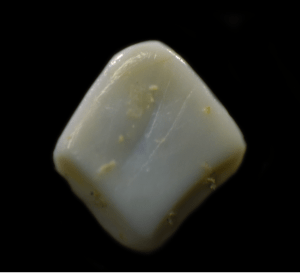
As I peered down through the ocular of my microscope at the diverse array of particles illuminated by the bright light above, I spotted countless sponge spicules (minuscule glassy spears that compose their porous skeletons), fish teeth, bone fragments, otoliths (fish ear bones), and the occasional strand of organic material or remnant chunk of calcium carbonate. These stood out against the black gridded background of my metal picking dish, recounting the history of the menagerie of creatures that left their mark on this particular patch of sediment before it was collected from the reef. Paintbrush in hand, I was ready to begin. However, I would be painting no masterpieces today.

I spread a small scoop – maybe equivalent to the size of a pinch of salt – of my sediment sample out over the area of the picking dish, trying to evenly distribute it and produce a single layer of particles. Now came the fun yet tedious part. I began to manually brush through the particles, visually scanning them with care in hopes that a denticle would catch my eye. Each time I found one, a little flurry of excitement would well up within me and I would suddenly feel like I had the endurance to pick for five more hours (as well as the inspiration to write a blog post). It’s a seemingly endless treasure hunt, but my tiny yet precious haul of denticles validates every minute of the search.

CAM00547_edit

The coral team kicks-off!

What did reefs look like before humans?. To answer this question, I joined the Baseline Caribbean project of Aaron O’Dea and his lab.

Reef corals are very important, for example, because they build “homes” for multiple reef critters—including delicious fish! Reefs also protect our coasts against storms and boost the tourism industry. Despite their importance, we know little about how reefs vary naturally and how they respond to human impact. This makes it difficult to conserve coral reefs and to sustain fisheries and tourism, among other valuable services.

To understand and manage coral reefs better, we project to investigate communities of reef corals from Bocas del Toro, Panama. Here, we had opportunistic access to sample pristine communities of reef corals—communities that lived approximately 7,000 yeas ago and, therefore, never experienced human impact. That opportunity was brief, during construction work (figure 1.a). Soon after sampling (figure 1.b-e), that fossil treasure was transformed into a lake and lost forever. Fortunately, our samples will provide robust evidence of what pristine coral reefs should look like. We will compare modern reefs with the pristine reference from the same region (figure 1.f).

yz14methods

Figure 1. Sampling fossil (a-e) and modern (f) reefs in Bocas del Toro, Panama.

Our project has an excellent home and family – its home is The Smithsonian Tropical Research Institute, which offers exceptional support including internships and fellowships. Its family are a bunch of people, rich in ideas and energy, and willing to work hard to make this world a better place. We are: Nicte-Ha Muñoz (intern, post-graduate student), Melisa Chan (intern, undergraduate student), Felix Rodriguez (staff research assistant), Andrew Altieri (co-advisor, staff scientist), Aaron O’Dea (principal investigator, staff scientist) and me, Mauro Lepore (the person to blame, fellow scientist). To learn more about us visit Aaron’s and Andrew’s websites.

Are you convinced that we have great intentions, ideas and team? If so, come back to this website; we´ll keep you posted!

Creating an acid digestion ‘factory’

While sieving the bulk bags of sediment allows us to constrain the particle sizes that we eventually pick for denticles, we are still left with around 260kg of sediment to work with. This is an enormous task, perhaps impossible. However, with acetic acid, we can make it feasible. Our samples are largely composed of coral and shell (calcium carbonate). These react with acetic acid to produce water, CO2, and calcium acetate, therefore eliminating the carbonate. This reaction can remove up to 99% of the sample weight, leaving behind just pieces of rock and resistant microfossils such as bone, teeth, denticles, and sponge spicules that we are interested in studying.

Our samples are so large that we’ve built a processing ‘factory’ outside the lab, where the sediment can react with acid and bubble off CO2 without ventilation issues or space limitations. Each size fraction is placed in a five gallon bucket, and acid rinses (10% acetic acid) are added daily over the course of about a week and a half. A little over 300L of 100% acetic acid is required to complete the digestion of the 65 bulk bags we collected in the Dominican Republic. That’s a lot of acid! We can also process 39 size fractions, or 13 bulk bags, simultaneously, which is 11 bulk bags more than what I was able to digest in the past using just the fume hood in the lab. This has cut the total digestion time down by months.

While this step requires a large quantity of acid to complete, it is crucial, as it turns the task of finding a needle in a haystack into the task of finding a needle in a small sprinkling of hay. Denticles are sparse in the sediment samples, but digesting away the calcium carbonate makes it possible for us to find them and reveal their secrets.

Panning for denticles

Like a gold miner crouched on the bank of a stream, shoveling sediment into his pan and hoping for a golden glint to catch his eye, we stood at the edge of a washing table, placing scoops of reef sediment onto our stack of sieves. However, we’re interested in something far more minuscule. Our collection of five sieves, with mesh sizes ranging from 63µm to 2mm, helps narrow the search by partitioning the sediment by particle size. Large pieces of dead coral and shell remain on the top mesh screen, while the smaller particles fall through and are caught by the finer mesh. Denticles are approximately 100µm to a little over 1mm across, so we process the 106µm-2mm size fractions to find them, saving both time and acetic acid. The very largest (>2mm) and smallest (63-106µm) fractions are stored in the lab for future use.

With two people working simultaneously, each 8-10kg sediment sample takes around two hours to sieve. After sieving, each size fraction is placed on a separate tray and deposited in our ‘drying bubble’ for a day or two until completely dry. It is then either digested with acid or stored. With one to two samples sieved per day, our mountain of bulk bags is gradually dwindling.

Phase two: return of the lab work

After several days’ wait, our precious and much-anticipated delivery of calcium carbonate cargo arrived at the lab upon clearing customs in the Panama City airport. Months of work went into preparing the agreements for these samples to pass into the country, and they were completed just in the nick of time. Now we were off and running with phase two. We also welcomed two new lab members to the team: Yamilla Samara and Henbelk Hernandez.

First, we had to unpack all of the samples from the crates and remove the plastic bags that they had previously been packaged in, allowing them to dry completely. In particular, the sediments collected underwater were still a bit soggy. Left outside or in the lab, these large, damp bulk bags could take a couple of months to dry completely without extra help. To expedite the drying process, some were moved to the ‘drying bubble’ that we had constructed in advance before leaving for the field. The drying oven that we had previously used was not nearly big enough for all of these new samples, so we decided to make our own! The ‘drying bubble’ consists of two metal bookcases, two dehumidifiers, and a fan completely enclosed by plastic, creating a hot, dry, confined space to dry samples simultaneously in large batches. It’s essentially a walk-in closet for sediment, complete with a Velcro sealed door flap. And trust me, it gets hot working in there. Now, this first batch of wet bulk bags would be dry in a week.

After each bulk bag of sediment is completely dry, it is weighed and stored in preparation for the next step: sieving. Fortunately, most of our fossil sediments were already dry, so no time was lost.

Mission accomplished … phase one, at least

Two weeks after crisscrossing the Dominican Republic from one compass extreme to another, the Baseline Caribbean team delivered their collection of reef fossils and modern reef sediments — all 800kg of it — to Santo Domingo’s Las Américas International Airport for shipping to Panama.

photo 2[1]

Erin and Félix carefully pack the crates at the Santo Domingo airport.

In all, the expedition logged about 1,500km on the road, three full field days exploring fossil reefs, 14 dives on modern reefs, two birthdays (Aaron had his b-day, too) — and only a couple of upset tummies from the mystery meat dishes and/or the choppy seas.

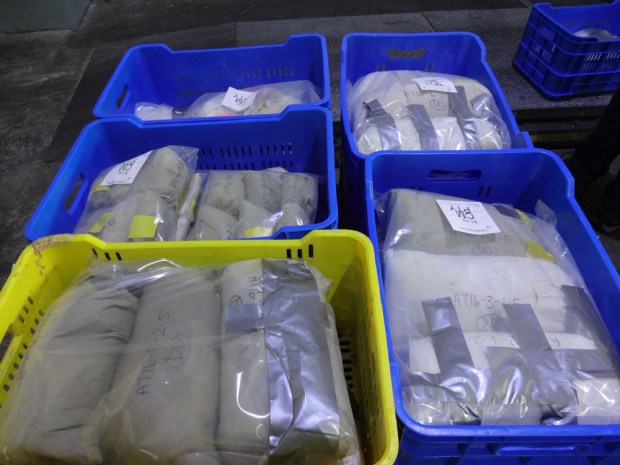
The 18 crates of samples include 65 large bulk bags and 130 small ones. “There are a lot of steps you have to go through to get them shipped,” said Erin. “Filling out papers with customs, checking the permits, waiting around, sending the samples through customs where some get randomly opened, and then packing them up nicely.”

If all goes as planned, the samples should arrive for analysis at the lab of STRI staff scientists Aaron O’Dea in the next few days. Then the “real” work begins — finding and identifying all the corals, dermal denticles and other traces of past and modern Caribbean reef in those bulk bags will take many months. But let’s not remind the team of that until everyone gets a much deserved rest after two nonstop weeks on the road!

DSC06551_1

Phase two: 800 kilograms of lab work


Farewell, Samaná

DCIM101GOPRO

Samaná under the waves

After three days of sampling in Samaná Bay, it’s time to pack up and head back to Santo Domingo with another 90 sediment samples. It was neat to see the differences between the fossil reefs of the Enriquillo Valley and their modern counterparts in Samaná, a bay with a similar form and comparable sheltered fringing reef environment.

While one of our study sites was home to a large thicket of living staghorn coral (Acropora cervicornis), most of the reefs we visited were devoid of this IUCN critically endangered species. All that remained were eroded fragments of their branches covered in algae and encrusting organisms. Instead, algae, sponges, the occasional coral head, soft coral, or gorgonian (sea fan) populated the sandy bottom. Starfish and urchins patrolled the substrate, but we saw few fish.

In contrast, fish were much more abundant at the reef with healthy staghorn coral. We spotted small parrotfish, wrasses, surgeonfish, lizardfish, and territorial damselfish tending their algal gardens amongst the branches of the staghorn coral. We even saw an octopus crawling along a crevice between coral heads. In this shallow habitat, we collected sediment between the living staghorn colonies or in areas containing its rubble. While we encountered large waves and wind during our visit, the bay is normally more quiet. As such, we found the sediment to be fine and silty — exactly what we were looking for.

Deeper on the reefs, the corals were more densely distributed than I had originally expected them to be. As on the fossil reefs, we collected sediment samples between the thickets of coral heads, including brain coral (Diploria), star coral (Orbicella), lettuce coral (Agaricia), and starlet coral (Siderastrea). We even observed some of the same coral species that we had identified a week earlier on the fossil reefs.

While our qualitative observations suggest differences between the mid-Holocene and modern reef communities, the next step is processing the sediment we collected to characterize the microfossils left behind by the inhabitants of these reefs — both common and cryptic. Now we just need to get the samples back to Panama!

—Erin Dillon


The reefs at Samana – a modern comparison

We reached Samana, in the very northeast of the island of Hispañola. This natural bay was a 17th century pirate hangout. We are here because the site is very similar in geography to how the Enriquillo bay would have looked 7,000 years ago — open to the ocean to the east, very sheltered, flanked on either side by mountains, with high run-off and sedimentation. It is critical we make our fossil and modern samples as comparable as possible in order to measure changes over time. We are therefore sampling the sediments in the reef crests and the fore-reef of fringing reefs around the Bay — just as we did in the Enriquillo basin. We were very surprised to see healthy-looking staghorn coral (Acropora cervicornis) in this region. Four years ago it did not look like this.

A guide to collecting a bulk sample

A bulk sample simply means that there is as little bias as possible during collection. Instead of picking the most beautiful or well-preserved fossils from an outcrop, we take whole lumps of the sediment, which are then transported whole back to the lab in Panama for washing, picking and identification of the fossils. Only then will the bounty they yield be revealed.

This means we have to collect massive amounts of rock and sediment, but it’s the only way to provide a measure of the abundance of the many different organisms in an ecological way. This ecological approach to paleontology is critical for we want to know what the structure of the whole ecosystem was like.

Sped up from 15 minutes to a minute and a half, the video shows Erin and Aaron collecting a 10kg bulk sample of 7000 year old reef sediments in the Enriquillo basin. All the coral, mollusks, fish otoliths, sponge spicules and shark dermal denticles will be picked from these to help reconstruct the ecosystems of the past.