This coral has been alive for a very long time…


This coral has been alive for a very long time…
Half of our proposed sampling sites were located in the lagoon. These words may strike fear in the hearts of some of the researchers who have dove in the lagoon before and seen large shadows lurking in the murky depths or fended off tiger sharks. At least these are the stories that people told me before my first lagoon dive. I wish they had told me after. You can throw rocks off the wharf into the lagoon and the sharks and giant trevally will come… and not just blacktip reef sharks, which I don’t mind hanging out with. There are tigers, lemons, grays, and potentially hammerheads that patrol the lagoon. The scariest part is that the visibility is so bad in some areas that you would barely be able to see them coming.


However, the sediment here is soft and silty (which further lowers the visibility when you dig into it and kick up a swirling cloud of silt). A mix of live and dead coral can be found where the lagoon flat slopes down into the lagoon proper, and there are some shallower patches toward the center of the lagoon. This is where we sampled.
Our first dive was in the West Lagoon, almost directly opposite the research station. We descended about 20ft along the slope before kneeling on the sandy bottom to start our work. Because of the incline, it was easier to kneel with my back to the lagoon. About halfway through each sample, I would nervously look back over my shoulder to make sure nothing big was there. And fortunately nothing ever was… at least on this dive.
Dana and I were lucky enough to get to do two dives on the forereef to retrieve some sensors from a mid-water mooring. Two-spot red snapper (Lutjanus bohar) lurked behind us and gave us toothy sneers as we swam around the reef, but no sharks were spotted on our quick dives. Still, the scenery was breathtaking!


Our story begins at a place called Penguin Spit, a reef located outside of the lagoon just south of the channel (lower left hand corner of the map). This is a commonly accessed reef on the atoll and the site of our first sediment collection. Situated safely behind the reef crest, this area is protected from much of the wave energy that batters the forereef. These waves and swell become abundantly obvious as you move offshore from the channel, and our tiny lagoon boats are only allowed with the boundary of the reef terrace for that very reason. The lower wave energy at Penguin Spit also means that there will be finer sediments that we can sample. Today, we were moored at Penguin Spit Middle, but later in the week we’ll head to Penguin Spit Inner as well, where the sediment is even siltier.

Sliding into the water from the boat, I was surrounded by a colorful mosaic of corals. The diversity and density were astounding! There were thousands upon thousands of corals. The coral cover for much of the reef was 100% or close to it, leaving us a just few patches of sediment to sample. My dive buddy, Dana, and I perused our surroundings, keeping an eye our for suitable patches of sediment and marveling at the hustle and bustle of the underwater city that surrounded us. Coralline bommies towered overhead and highways of convict tang and juvenile parrotfish cruised by. We later accompanied the person who wrote the narration for March of the Penguins here, and his first impression was one of pure astonishment. This place can really take your breath away.
However, even on this remote reef, there is a pernicious intruder. Thought to have first been introduced by the shipwreck of a long line vessel on the reef terrace north of the channel in 1991, corallimorph (Rhodactis howesii) has crept across the reef, displacing other corals. Even after the removal of the wreck, it continues to spread, leaving scientists scratching their heads. Efforts are in the works to try to curb corallimorph growth, which otherwise could threaten the dominance of corals on these reefs. In the picture below, it is the anemone-like organism crowding out the sediment patch that we sampled.


Palmyra Atoll is very much located in the middle of the Pacific. So how does one get there, you ask? There are two primary modes of transportation: by plane or by ship. We cut to the chase and flew. The flight from Honolulu was around 2.5 hours, and the plane (see below) was certainly an upgrade from my trip in 2011. After a bumpy landing – complete with food and coolers flying around the cabin – we disembarked and began preparing our field gear for the next day’s sampling. We had arrived in own scientific paradise.


I just returned from a fruitful month-long expedition to Palmyra Atoll, a tiny atoll within the Northern Line Islands located approximately 1,000 miles southwest of Hawaii. While previously occupied by the US Navy during World War II, Palmyra is now protected as a National Wildlife Refuge by the United States. The Navy drastically altered Palmyra’s landscape by extending existing islands and building new ones, constructing causeways to connect these islands, and dredging a channel to allow access to the lagoon. Despite these terrestrial perturbations, the coral reefs surrounding the atoll have remained largely untouched, offering scientists a glimpse into the inner workings of a healthy coral reef ecosystem. Here, sharks abound, providing a stark contrast to the relatively depauperate reefs from which we collected sediment in the Caribbean. Palmyra Atoll is of particular relevance to our study because the shark populations there are both large and well-characterized, giving us the opportunity to validate and refine our use of dermal denticles preserved in sediments as a time-averaged proxy for living shark assemblages on reefs.
Palmyra Atoll is also where I first discovered my passion for coral reef ecology. In 2011, I assisted with field work on Palmyra’s lagoon flats as an undergraduate student at Stanford. While most of my time was spent in the sandy shallows, I went snorkeling on the reef terrace on several occasions. There, plunging into the aquamarine waves, I came face to face with a shark, then two, then three. Never before had I been in the company of a reef so full of predators. This was the first time I had directly observed the ecological splendor of a protected coral reef. It was as if I had been transported back in time to glimpse how reefs may have operated before humans. Three years later, when I began working on the dermal denticle project with Aaron, applying this technique to Palmyra was always in the back of my mind. It’s incredible to now make this idea a reality and share it here with you.
While WordPress was not working on our internet servers on the atoll, preventing me from posting live from the field, I will now be publishing my experiences collecting sediment on Palmyra in regular installments.


Earlier this year, the coral project was set. The research question was clear, the samples – the key to the question – were at hand, and I was making good progress. But the coral team had only one member: me. This was not great because I love working in teams and to learn new stuff. How best to learn if not by teaching?
Potential interns had shown interest in working in the lab. Not always, however, this works well for the intern or researchers. It is hard to find a good match. Then, a young woman emailed Aaron. Shortly after, she was standing in front of us. “Gosh! Nicte-Ha is very determined”, I initially thought. And she was.
On day one, Nicte-Ha said that she aimed to find a research job in Bocas del Toro. We were sitting hundreds of kilometers from Bocas, but for Nicte-Ha, we were pretty close. A few hours after she analyzed the last sample in our lab, she headed off to Bocas del Toro.
What do you think happened between day one and the last sample she analyzed? Success! That is what determined people consistently get. Just to name a few of her achievements, Nicte-Ha learned fast and taught others, analyzed hundreds of kilograms of coral samples, developed and presented a poster at a conference, and was actively engaged in the daily life and discussions of our scientific community. More than anything, she got a special place in everyone’s heart.
Thank you, Nicte-Ha. Today we see you leave, moving in the direction you chose. We are happy and proud.
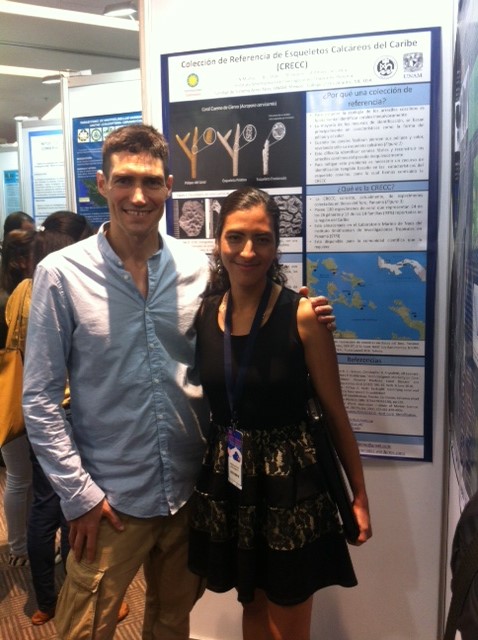
Nicte-Ha Muñoz presents a poster in APANAC.
The coral team has great news to share: one reef from Bocas del Toro may be a bright spot! This blog explains what a bright spot is, why it is important and where we may have found one.
Coral reefs are declining worldwide but not all of them are in bad shape. Bright spots are, among coral reefs, those reefs that are in better condition than expected given the environmental and socio-economic conditions they are exposed to (Cinner et al. 2016). If we can learn why bright spots are different, we may be able to improve degraded reefs. But first we need to identify bright spots! And we may have found one in Bocas del Toro, Panama.
To do this, we became time-travelers! We compared (fossil) reef corals that lived in Bocas del Toro around 7 000 years ago (figure 1a) with (subrecent) reefs corals that have lived here over the past few decades (figure 1b). We measured the amount and type of reef corals both in fossil and subrecent reefs. From this data we are learning how reefs changed since substantial human impact began.
Our preliminary results show that one reef from Bocas del Toro, Punta Caracol, is a potential bright spot. Compared to other subrecent reefs, Punta Caracol is exposed to similar environmental conditions and human pressures but it seems substantially healthier. In fact, it is almost identical to the pristine reefs that lived in the region 7 000 years ago.

Figure 1. When fossil (a) and modern (b) reefs from Bocas del Toro are compared, Punta Caracol is outstanding, likely a bright spot. It is healthier than other subrecent reefs and similar to pristine reefs that lived in Bocas 7 000 years ago.
Our next step is to refine this exciting finding. We plan to precisely describe how Punta Caracol is special. For example,
We will let you know what we find out!
There are 15 hours left in our crowdfunding campaign and we are 101% funded. If you want to make a last minute donation to show your support, there is still time remaining. Thanks so much to everybody who backed our project during the campaign! YOU are making our work possible.
Stay tuned in February as we travel to the reefs of Curaçao and share our experiences from the field.

$3000 to go with just three days remaining! If you think sharks are cool, consider donating just $5 to support our cause. Also, please share our project campaign across your social media and friend networks. We’ll need to reach our goal to receive the funds, and our field work won’t be possible without your support. We can make this happen!
You can support our work and learn more about the project here.

Today we say farewell to Melisa! Because she has done great and has big plans ahead, we want to celebrate.

Melisa never gets stuck (except this one time)!
During her three-month internship, Melisa was outstandingly productive. For example, she (a) identified over a hundred kilograms of tiny coral fragments, (b) planned a fieldtrip, (c) reviewed literature, (d) developed a guide and a reference collection to identify coral skeletons, (e) wrote an abstract and produced a conference poster, (f) presented interesting topics at multiple lab meetings, (g) attended to multiple scientific seminars and (h) organized the research collection of the coral team. And most importantly, Melisa connected personally with everyone she met. She is easy going, kind, and respectful.
But the semester starts soon so she has to go back to college. For her farewell, we gave Melisa a little present and took her out to lunch. The restaurant we chose was Napoli’s Restaurant and Pizzeria, a place that has hosted the special occasions of the O’Dea lab and its scientific family, including the legendary Tony Coats and Jeremy Jackson, over decades.
The coral team, the O’Dea lab and many others at the Smithsonian Tropical Research Institute will remember and miss her a lot. Because she is smart, positive and hard working, Melisa will never hit a roof. So I am confident this is only the beginning of something even bigger and better.
Melisa, we wish you the best because you deserve it!
A new lab note has been posted for our crowdfunding campaign, which shares some preliminary observations from Curaçao made during our trip last year. You can check it out here!
We’re 25% funded with 19 days to go! Thanks to all of our backers so far. This field work will not be possible unless we reach our funding goal.

Denticle of the day: Scanning electron microscope image of a lemon shark (Negaprion brevirostris) denticle at 245x magnification. Scale = 100 micrometers.
Thanks to everybody who donated during the first week of our crowdfunding campaign! We really appreciate your support. Every little bit counts, and we’ll need to reach our goal of $4,000 in the next three weeks to receive the funds for our next field work mission. Again, please check out our project at experiment.com/sharkskin and share it with your friends and colleagues. This campaign will help us uncover the history of sharks on reefs in Curaçao and keep the ‘Baseline Caribbean’ blog posts rolling.

Yesterday evening, Aaron and I launched a crowdfunding campaign as part of Experiment.com’s Coral Reef Challenge. We are raising money to support our upcoming field work in Curaçao, which will supplement an award we received at the Association of Marine Laboratories of the Caribbean scientific meeting last year. You can check out our campaign’s page and learn more about what we’re planning to do at experiment.com/sharkskin. The campaign participating in this challenge with the most donors by September 13 will win an additional $1000, and our campaign will run for a total of 30 days. We must raise at least our goal of $4000 to receive the funds. We’ll need your support to reach this goal and keep the blog posts flowing as we collect more samples for the Baseline Caribbean project. Donors will receive a shoutout on our Baseline Caribbean blog as we report live from the field, so keep an eye out in February. Thank you in advance for your support!
-Erin
Now that we’re finishing up with the material that we collected from the Dominican Republic this year, we’ve set our sights on Curaçao, which is an island located in the southern Caribbean. Stay tuned next week as we begin to release more information about our upcoming plans.


 Baseline Caribbean