Blog

Beautiful forms and incredible functions

Dermal denticles are small scales that line the skin of sharks. Denticles have a similar composition to teeth, forming a strong and streamlined suit of armour. If you were to pet a shark, its skin would feel smooth in one direction and rough like sandpaper in the other direction. This is due to the serrated peaks of the layer of overlapping denticles that cover the shark’s body.

Denticles are continually shed by sharks and accumulate in marine sediments, where we can find them beautifully preserved – in both on modern and fossil reefs.

shark denticle family diagram (blog body)

Denticles display a diversity of forms and play a variety of functions. For example, fast predatory sharks – such as hammerhead and requiem sharks – are covered almost entirely by thin, highly ridged denticles that reduce drag and make the shark more hydrodynamic. This type of denticle served as inspiration for the controversial Speedo swimsuits in the 2008 Beijing Olympics.

In contrast, demersal (bottom-dwelling) sharks are have thicker, smooth denticles that resemble pebbles. These protect against abrasion, given that their owners live along rocky, sandy, or coralline substrates.

Other demersal or schooling sharks possess spiny, defensive denticles that are thought to discourage the settlement of parasites and epibionts on the skin.

To make sense of the different types of denticle we had to first build a reference collection of modern denticles from museum collections of sharks. That way, when we find a denticle in a fossil reef we have some idea of which type of shark it could have come from and the way the shark lived.

One big problem is that denticles are rare and that is why we have been collecting so many hundreds of kilograms of fossil and modern reef sediments. Once back in the lab, we will dissolve the calcium carbonate that forms much of the sediment in our bulk sample bags using a process pioneered in Richard Norris’ lab. Picking them is arduous for they are usually less than half a millimetre in size. We hope to find enough to be able to rigorously compare the assemblages of denticles across our sites.

Cañon de Buho jpegs_mini (9 of 9)

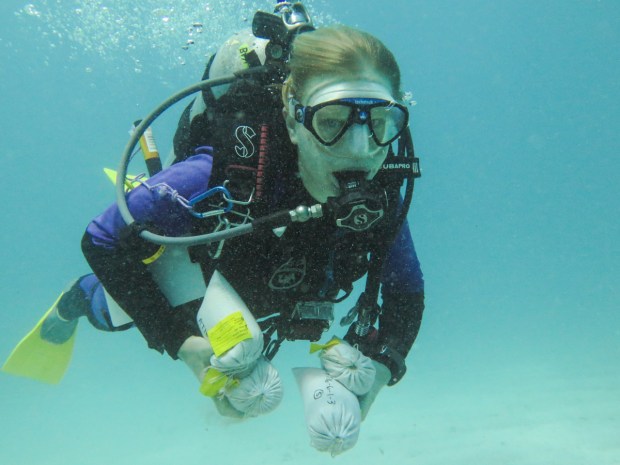
Erin and Félix carry off heavy bags of samples for analysis.

If we get lucky, the denticles from modern Caribbean reefs could tell us about the presence of sharks in areas where fish surveys have failed to report them because of their rarity, yet dive shops and fishermen confirm their presence.

Even more exciting is the possibility that we will uncover enough denticles from the fossil reefs to be able to reconstruct shark populations 7000 years ago, before major human impact.

It’s hard work but we hope that these massive bulk bags of reef sediment will uncover enough tiny denticles to help paint a picture of shark communities past and present.

DILLONE_320_Fig 1 (body)_Great hammerhead_body_275x, Erin Dillon & Jorge Ceballos


¿Porqué los moluscos de hace 7,000 años eran mas grandes y fuertes?

Félix Rodríguez nos comparte unas observaciones sobre los fósiles de moluscos que hemos encontrado durante la expedición:

Después de los corales fósiles que hemos visto, los moluscos son los mas diversos y abundantes en los sitios donde estuvimos, tanto al norte como al sur del Lago Enriquillo. Lo que mas llama mi atención de estos moluscos es su preservación, algunos incluso

MAO_5691

Félix en Samaná, República Dominicana.

mantienen matices de color. Además  se ven como si estuvieran suspendidos en el tiempo, es decir, son una real fotografía del pasado de hace 7 mil años. Otro aspecto interesante de estos moluscos fósiles es su gran tamaño y grosor, comparándolos con los actuales, que son mas pequeños y frágiles, siendo las mismas especies  en algunos arrecifes donde actualmente estamos trabajando. En mi mente surgen varios interrogantes: ¿Qué ha cambiado? ¿eran mas longevos los moluscos que hoy día? ¿había mas alimento para ellos? ¿es por esta razón su talla y grosor? Por el momento, no hay una respuesta, pero de seguro esto nos ocupará tiempo en responder.


Exploring Punta Cana in pictures

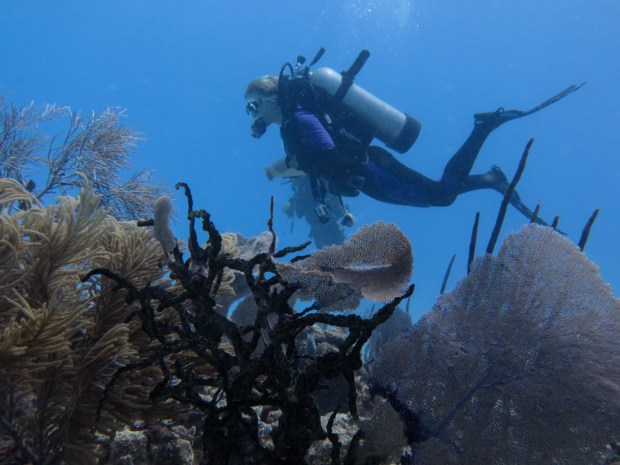
With fantastic help from Victor Galvan and the team at the Punta Cana Ecological Foundation, we found a few underwater sites with potential for the dermal denticle project. The foundation also showed us their successful coral nursery and out-planting sites for Acropora cervicornis, which is being placed on dead reefs for recolonization. A no-take zone that covered one reef site was impressively full of fish for a degraded reef site, a sign that populations can recover quite quickly, even in a small area where no fishing is allowed.

Blue Vision Adventures kindly gave us access to their excellent dive facilities.

Off to dig at Punta Cana

STRI pre-doctoral fellow Erin Dillon talks about the start of the sampling day at Punta Cana and how she hopes to discover shark dermal denticles in the reef sediments.

This region is massively developed tourist destination with its own private airport. Few sharks are officially reported on the reefs here but fisherman claim to catch hammerheads. If there are many hammerheads that are avoiding surveys the sediments in the reef should preserve their denticles…

Photos to follow soon

Modern Caribbean reefs: where are the sharks?

Sharks aren’t easy to spot on many, if not most, Caribbean reefs these days so figuring out what species remain and in what amount is a daunting task. Even though sharks are rare, they still leave traces behind — dermal denticles, their tiny tooth-like scales. Finding these can tell researchers like STRI fellow Erin Dillon what a shark community looks like, no matter how small it is.La Caleta (1 of 4)

But finding dermal denticles is only slightly less difficult than seeing a shark on a reef dive. They are so small that most can only be seen under a microscope and even relatively large concentrations are equivalent to about 25 per 10-kilogram sack of sediment. So identifying the correct site to sample is essential. These spots are often what scientists call low-energy sites, meaning they are not subject to strong wave action or currents, which sweep tiny particles like denticles away.

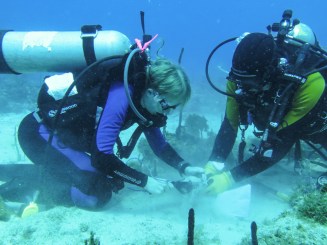
When a potentially apt site is identified, it’s time to get to work. Today, Erin and Mauro Lepore dug up some 100 kilograms of sediment. Doing so required that they carry more La Caleta (3 of 4)weight than usual in order to stay put on the sea floor when pushing into the hard surface. Otherwise, each thrust of the trowel would push them up from the bottom. It’s also important to avoid losing any fine sediments by digging too vigorously. When each sample bag is full, Félix Rodríguez, the O’Dea lab manager, drops a line down with a mesh bag and hoists the bags to the surface.
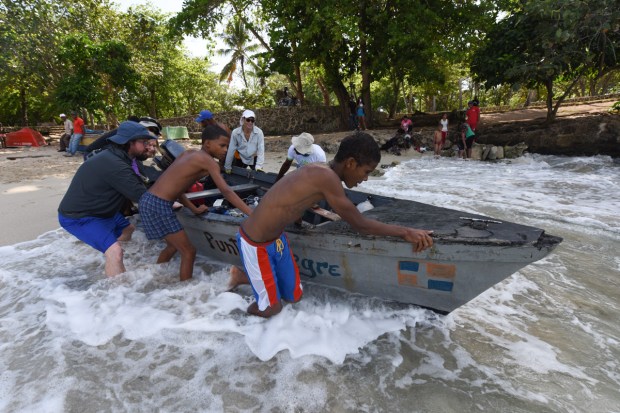
Erin, Mauro and Félix are just beginning their trek around the reefs of the Dominican Republic. Over the next few days they aim to gather another half ton of sediments. And while that might sound like hard work, once the samples are back at the lab of STRI scientist Aaron O’Dea in Panama, it will take a solid year (and an intern or two) to digest all the material (a process that involves copious amounts of acid). This, they hope, will get us one critical step closer to learning just how drastically shark communities on Caribbean reefs have changed since humans became the major driver of their decline.

The fall and rise of Lake Enriquillo

One of the problems of trying to work out what coral reefs were like before human impact is that the reefs of the past are underneath the reefs of today.

One way to get to these reefs is by coring through the reef and producing a timeline of the coral reef as it grew. This is great for small and common fossils, such as molluscs and fish teeth, but the core itself is only 10cm in diameter and so very large animals (such as large coral heads) and very rare fossils (such as shark dermal denticles) are not captured. This means the complexity of the coral reefs is often missed.

One way to get to the whole reefs of the past, and capture the full variation and natural complexity of the reefs, is wait for an excavation to dig out and drain the modern reef, exposing the fossil reef underneath. In Bocas del Toro we had the good fortune to be able to explore one such massive excavation – see the video here.

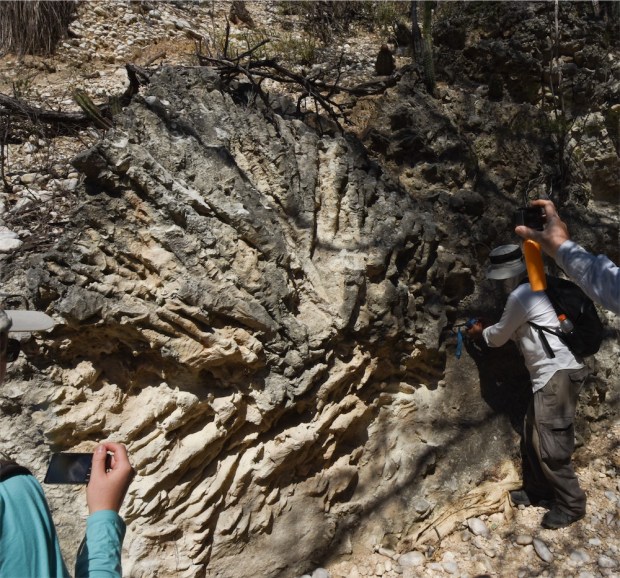
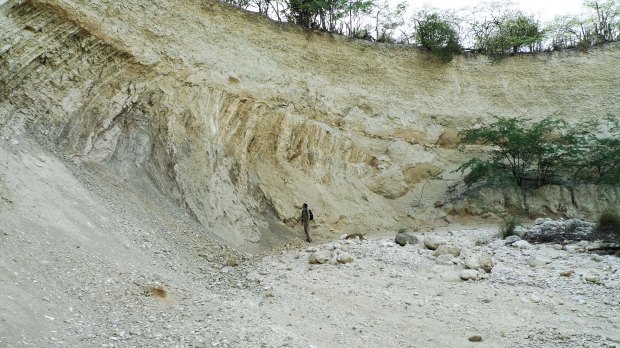
The Enriquillo Lake in the Dominican Republic was originally a marine embayment, flanked by hills on either side and open to the ocean to the east. The coral reefs fringing these hills are those we are studying. Around 4,000 years the River Yaqui del Sur deposited a large delta right in front of the entrance to the bay, sealing it off from the open sea. Bbecause the area sits in a rain shadow, evaporation exceeds precipitation and the lake began to dry out. Eventually the lake level dropped to below 40m below sea level and became hypersaline. With the reefs exposed above the lake level, storm channels started to cut through the ancient reefs and it is in these small canyons that we get to see the incredible full sections of coral reefs that grew between 6,000 and 9,000 years ago.

Recently, the lake level has started to rise again and nobody is sure why. Many theories have been proposed from climate change to natural variability. Whatever the cause, the impact on the local communities around the lake is devastating as it eats up the little arable land they have, and drowning the roads that encircle the lake. The government seems to be taking steps forwards helping and have started building a new road 20m or so above the lake level.

The problem for us is that if the lake continues to rise at the steep rate of recent years, within a decade these spectacular fossil reefs could once again be under water, and unavailable for study.

Fossil shots_p3 (1 of 1) 1

Finding a needle in a haystack to reveal shark baselines

Team at Las Clavellinas-Erin (2 of 8)

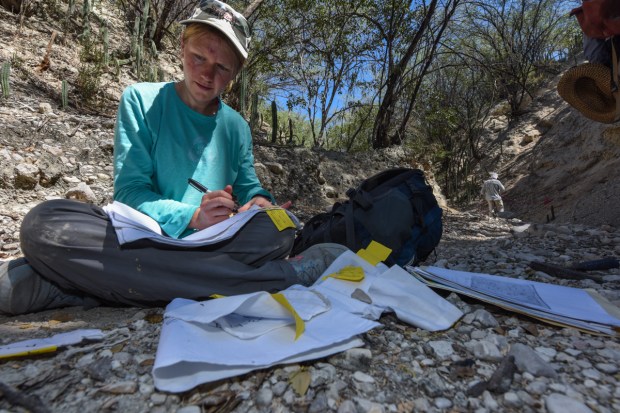
As we hiked through cactus and traversed down the side of the canyon toward our first sampling site, I marveled at the terrain and how un-reeflike it appeared at first glance. We then reached the beginning of the reef, or what was a fringing reef 7,000-9,000 years ago. I was blown away. A diverse thicket of corals and molluscs – representing thousands of years of growth – towered over me on the canyon walls. The preservation of details was extraordinary, allowing me to identify coral species as I strolled through the site. Not only was I walking upward through the reef zones – as if diving on a modern reef – but I was peering at the growth of the reef across time. The three-dimensionality of this fossil reef was incredible, and it challenged me think about reefs from an entirely new perspective.

Over the past three days, we collected sediment samples from four fossil reefs. These sites give us unique insight into what healthy reefs were like before people. In particular, I am interested in characterizing the shark communities in the past and understanding how they have changed over time. How can we do this, though, if there aren’t many shark teeth in our samples? Instead, we have found that sharks leave their mark in reef sediments in the form of dermal denticles – tooth-like scales that cover their skin. Denticles are no bigger than a couple strands of hair, yet are well-preserved in the fossil record. They also display a variety of forms that reflect shark ecology, allowing us to reconstruct community composition.

However, this valuable insight comes with its costs. We have found that denticles are rare in reef sediments. This means that we have to collect a large quantity of sediment to obtain a sufficient number of denticles to analyze. We have already collected 300kg of sediment that I will use to extract denticles. Over the course of our trip, we hope to collect 900kg of sediment from the modern and fossil reefs we visit. Processing this sediment will require around 100 gallons of acetic acid to digest the carbonate and months of work sieving and picking out the denticles under a microscope. I expect to find 25-30 denticles in each 10kg bulk bag, yielding about 2,250 denticles. This 900kg of material will thus be reduced down to about a gram of denticles, a pile small enough to easily fit in the palm of your hand. These tiny microfossils can reveal pre-exploitation baselines of sharks on reefs, which are currently unknown. They can also supplement our understanding of sharks on modern reefs in the Dominican Republic and how their assemblages have shifted over time due to human activities. Unlocking this missing information about the status of unfished shark communities is crucial to better conserving them in the future. This unusual trip to the desert allows us to turn to the past to help protect the future of reefs.

The team tackles a 12-meter wall of fossil coral

We made it to Las Clavellinas and its monstrous wall of Acropora Cervicornis, a reef-building coral that is a threatened species today but was clearly abundant in Caribbean reefs 7,000 years ago. Here we collected another five bulk samples (10-kilogram cloth bags), and ten smaller bags, that will be brought to Panama and painstakingly picked apart for their tiny shark dermal denticles (all 25 or so per bag), sponge spicules, mollusks, and corals. The amazing Mauro Lepore and Félix Rodríguez were the climbers-in-chief, but everyone on the team had the chance to hack a bag of samples out of the hard fossil wall.


Searching for shark scales and the story they tell

In a staghorn coral reef at Las Clavellinas on the northern edge of Enriquillo Lake in Dominican Republic, Erin Dillon, a fellow at the Smithsonian Tropical Research Institute, talks about how she plans to extract the dermal denticles (tooth-like scales) of sharks from the 7,000-year-old reefs, and how that can help us better understand what Caribbean shark communities used to be like before humans.

Four fossil reefs done

The preservation of the coral reef fauna, which includes sea urchins, bryozoans, bivalves and gastropods, among others — and the sheer extension of the reefs here in Enriquillo — amaze us each time we walk one of these canyons.

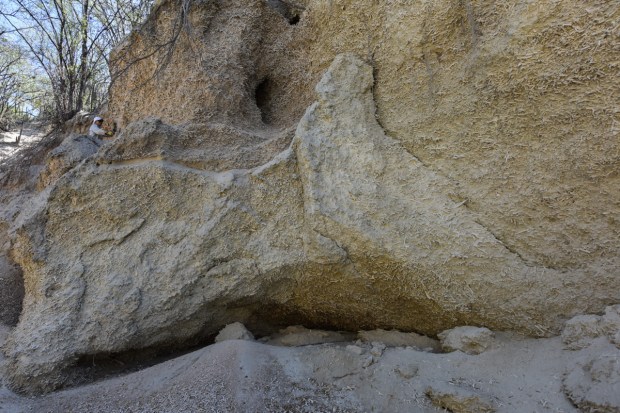
Each canyon shares a similar aspect with the reef crest at the upper reaches, which is predominantly Acropora cervicornis (staghorn coral) in life position, i.e. it was frozen in the fossil record in the exact position it had 6,000 years ago when it was surrounded by seawater. The reef section then drops down into fore-reef habitats comprised of many coral heads dominated by Siderastrea, Diploria and lots of Orbicella. The Siderastrea and Orbicella reveal an interesting draping growth pattern (see photo) which has been suggested to have been caused by periodic high sedimentation from erosion of the mountains that surround the Lake. These sediments smothered the corals causing partial mortality.

Despite living in this Fossil shots (7 of 12) 1environment of high sedimentation, these corals were able to not only deal with the conditions, but clearly thrive. Many of the Orbicella and Siderastrea colonies underwent hundreds of these events and continued to regenerate and build massive corals, like this example. Why did these corals thrive in these conditions while Caribbean corals fail under similar high rates of sedimentation? To me, that’s a hugely interesting question.

At each site we samples the A. cervicornis reef crest and the deeper fore-reef as distinct habitats that are easy to distinguish. So far we have sampled four sites: Cañada Honda, Las Clavellinas and Los Rios on the north of the lake, and our first site Cañon de Buho on the southern edge. We have collected 30 large bulk bags at 10kg each and 60 small bulk bags at 1kg each. The truck is getting weighed down!

The large bulk samples will be split into two size fractions – sediments greater than 2mm, which we will use to reconstruct the coral, mollusk and urchin faunas, while the sand fraction smaller than 2mm will be digested with large quantities of acetic acid, which will remove the calcium carbonate, hopefully leaving behind the shark dermal denticles which are generally lass than a millimetre in size. STRI fellow Erin Dillon will tell you more about that soon.

One of the two smaller bulk bags will be used to pick the otoliths (ear bones) of reef fish and the other will be used for the extraction of the sponge spicules and sediment analysis, to find out how big were the grains and how much organic material and carbonate they contain. With all these environmental and faunal components of the reef we hope we will be able to reconstruct many of the important aspects of these 7,000 year old Caribbean reefs to quantitively describe what “pristine” Caribbean reefs were really like.

Soon we will leave Enriquillo and start collecting sediments on modern reefs around the Dominican Republic to make a direct comparison with what once was with what exists today. I fear the modern may be somewhat depressing when we compare with what we have.

Download the google earth file of our tracks and sampling sites here.